
The Warsh Proposal: Fed-Treasury Coordination as Monetary Regime Shift
How a “New Accord” Could Quietly Put the Fed Under Treasury’s Thumb

I run this newsletter in a very human way.
I assume you’re smart. I’m not here to squeeze short-term gains out of anyone. That might work once, but it doesn’t build trust, and it doesn’t last.
What does last is simple: every annual subscriber should clearly benefit — through useful contents or practical tools — in a way that’s consistent and real.
The Pine Script tools (with source code and a user guide) have already been sent to your email. Please take a look when you can. If you run into any bugs, let me know — I’ll get back to you within 48–72 hours.
If you’re a new annual subscriber, you’ll receive the same tools as well. The tools is designed to support your trading in a practical way.
At the end of the day, this publication runs on two things:
Annual paid subscribers who stay longer than a year
A total of more than 200 annual subscribers
If those are strong, this continues.
If not, it won’t.
I don’t know how long this will run. I’m also building a small e-commerce project to create more stable side income, but my time is split. But as long as enough people choose to commit annually, I’ll keep showing up and building this the right way.
If this publication has helped you think more clearly, make better decisions, or see things differently, then it’s doing what it’s meant to do.
Not because you feel pressure.
Not because you feel obligated.
But because you truly find value in it.
That’s the only way this works.
Thank you for being here.
Jin
Introduction
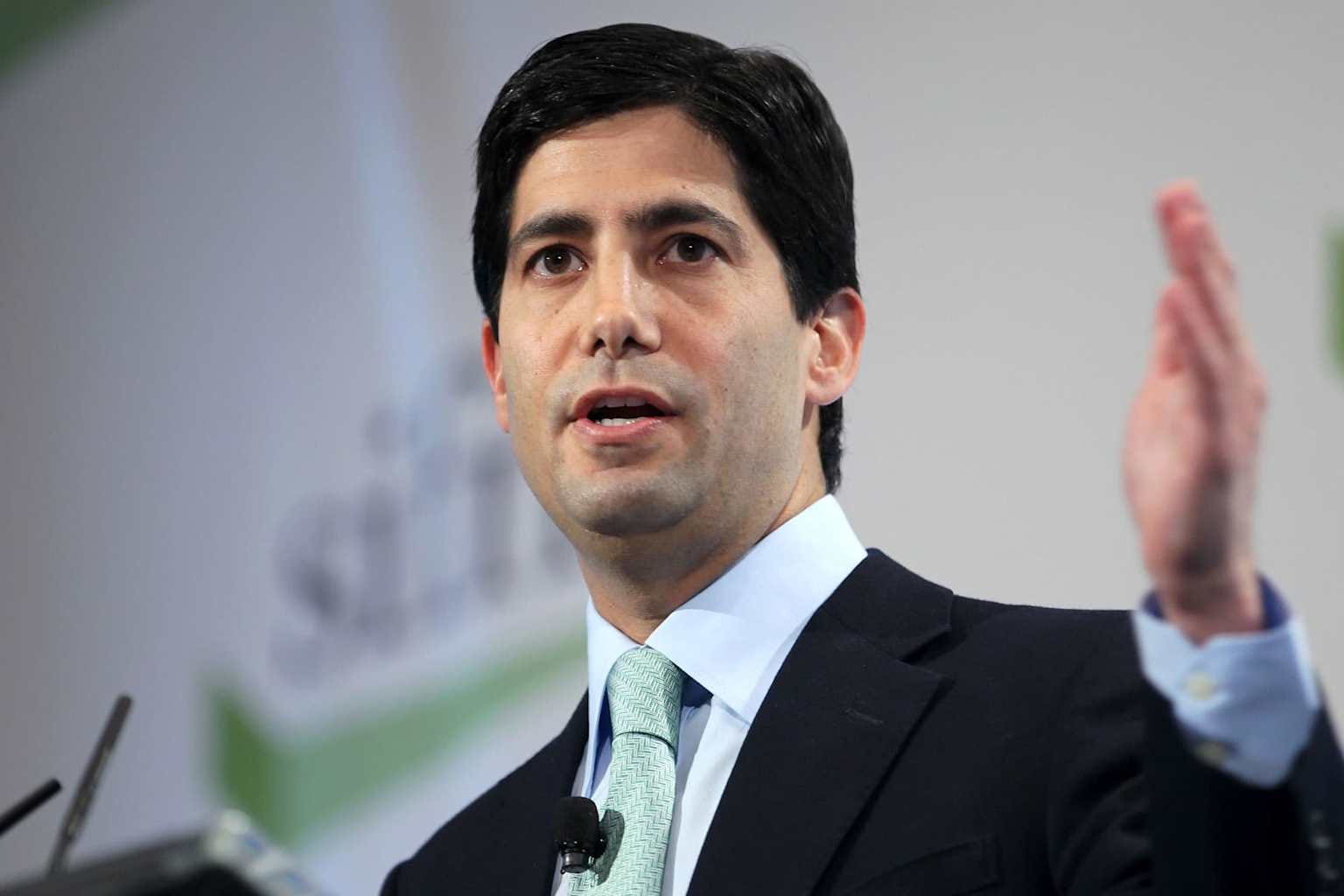
Kevin Warsh’s nomination to replace Jerome Powell in May 2026 carries implications far beyond typical Fed chair transitions. His explicit call for a new Treasury-Federal Reserve accord—echoing the 1951 agreement that originally established Fed independence—has triggered substantial debate about whether this represents pragmatic coordination or structural subordination of monetary policy to fiscal needs.
The market’s central question: Does bilateral coordination mean technical improvements in balance sheet transparency, or does it signal yield curve control by another name?
The Core Proposal
Warsh’s framework centers on two commitments:
Balance Sheet Path Clarity: The Fed would establish explicit, forward-looking guidance on the size and trajectory of its balance sheet
Debt Issuance Coordination: Treasury would align its issuance calendar and maturity composition with Fed liquidity operations
As of February 18, 2026, the Fed’s balance sheet stands at $6.6 trillion, down from its April 2022 peak of $8.97 trillion but still approximately seven times its pre-2008 baseline of roughly $870 billion. Quantitative tightening formally ended December 1, 2025, earlier than most market participants expected. Treasury Secretary Scott Bessent has publicly stated the Fed will remain “cautious” on further balance sheet reduction.
The timing matters. Q1 FY2026 saw $270.3 billion in federal net interest costs. On an annualized basis, this projects to approximately $1.08 trillion in interest expense on $38.56 trillion total debt. FY2025 recorded $971 billion in net interest payments, representing a 2.6-fold increase from FY2019’s $375 billion. With the 10-year Treasury yielding 4.29% as of February 4, 2026, and hovering around 4.08% in late February, interest costs remain a mounting fiscal challenge. Even at these levels, modest rate increases compound fiscal stress given the debt’s unprecedented scale.
Historical Context: The 1951 Precedent
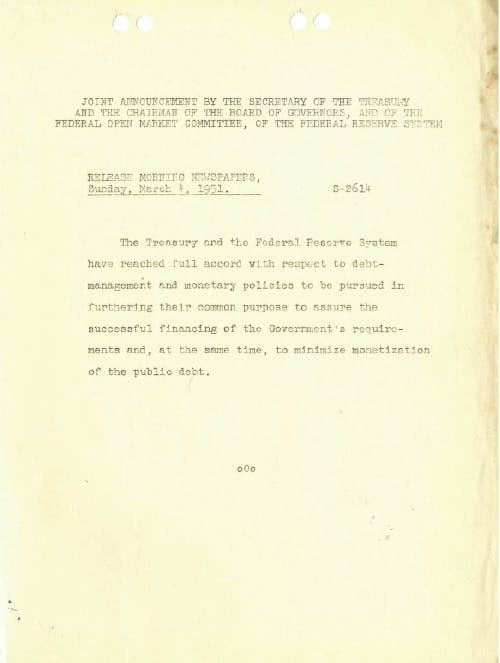
The original Treasury-Fed Accord resolved a genuine crisis. During World War II, the Fed pegged Treasury bill rates at 3/8 percent (0.375%) and capped long-term bonds at 2.5% to facilitate war financing. Post-war inflation pressures mounted, and by February 1951—amid intensified Korean War financing needs—CPI inflation reached an annualized rate of 21 percent. The Fed remained trapped in supporting Treasury issuance at sub-market rates even as inflationary pressures surged.
By early 1951, the conflict reached breaking point. President Truman pressured Fed Chairman Thomas McCabe to maintain the peg; McCabe and the FOMC resisted, though ultimately participated in negotiations. The accord, reached on March 3 and announced March 4, 1951, freed the Fed from yield targeting obligations, establishing the foundation for modern central bank independence.
Warsh explicitly invokes this precedent but proposes coordination rather than separation. The distinction is critical. The 1951 accord ended yield curve control; Warsh’s proposal could institutionalize coordination that leads functionally toward it.